A direction for your next space
Contemporary Bathroom with Freestanding Tub
About this design
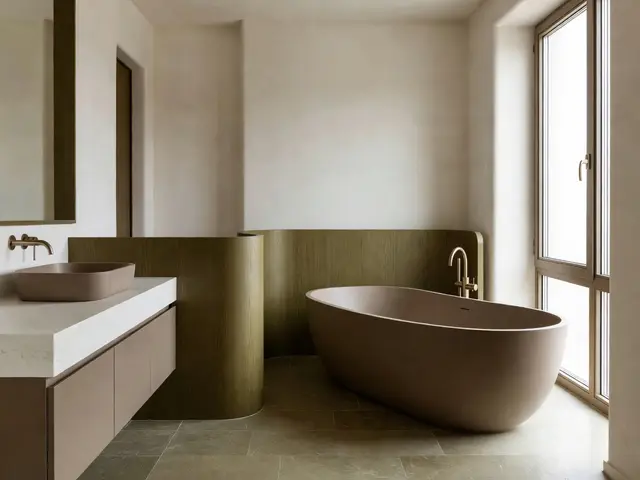
This contemporary bathroom uses a palette of warm white, olive, and taupe to create a serene bathing space. A sculptural oval tub sits beside a tall window, separated from the vanity area by a curved olive-green wall panel that wraps from floor to mid-height. The floating white vanity holds a single vessel sink with wall-mounted faucet, positioned beneath a rectangular mirror. Large format floor tiles in muted gray-beige extend throughout, while the upper walls remain white, allowing natural light to fill the space.
Design this look with your photo ↗Your room photo + this reference. Review the studio allowance before generating.
What stands out
- The curved olive wall panel divides the space functionally while maintaining visual flow, its rounded corner softening the transition between bathing and grooming zones without requiring a traditional partition.
- The freestanding tub's smooth, rounded silhouette echoes the curved wall, creating a cohesive sculptural quality that defines contemporary design through organic forms rather than sharp angles.
- Wall-mounted plumbing fixtures keep surfaces clear and emphasize the floating quality of both the vanity and the tub, contributing to the uncluttered, grounded aesthetic.
- Large format floor tiles minimize grout lines and create a continuous surface that visually expands the room, their neutral tone bridging the olive and white palette.
Make it work in your space
In a smaller bathroom, keep the curved wall element but reduce its footprint by using a quarter-round instead of a full curve. Swap the freestanding tub for a smaller Japanese soaking style or an alcove tub with a deck-mounted faucet to save floor space. Use the same olive tone on a single accent wall rather than paneling to maintain the color story affordably. Skip the vessel sink in favor of an integrated sink and countertop for easier cleaning. Retain the floating vanity and large tiles, as both make compact spaces feel larger.
Check tub access, floor support and cleaning space around all sides.
Materials and finishes
- Curved wall paneling
- Look for panels that can bend to your desired radius. Consider moisture-resistant materials like solid surface or treated wood. Seams should align vertically for a clean appearance.
- Large format floor tile
- Choose tiles at least 12 by 24 inches to reduce grout lines. Verify your subfloor can support the weight. A matte or honed finish prevents slipping when wet.
- Floating vanity construction
- Ensure wall studs are located and reinforced before installation. The cabinet should be mounted to blocking, not just drywall. Leave clearance beneath for cleaning access.
- Vessel sink material
- Select a non-porous material that resists staining and standing water. The rim height affects faucet placement, so plan both together. Consider how the bowl depth suits daily use.
- Freestanding tub finish
- Matte composite materials hide water spots better than glossy finishes. Check the weight when filled to ensure your floor can bear it. Interior texture affects how easily you can clean it.
More Contemporary Bathroom Ideas
Your questions, answered
How do you clean a curved wall panel in a bathroom?
Wipe curved panels with a microfiber cloth and mild all-purpose cleaner, working from top to bottom. For textured or wood-look surfaces, spray cleaner onto the cloth rather than directly on the panel to prevent moisture from seeping into seams. Dry immediately with a separate cloth to avoid water spots. In high-moisture areas, check seams monthly and recaulk if gaps appear to prevent mold growth behind the panel.
How do I try this look in my own space?
Choose Design this look and upload your own photo in the studio. This concept is loaded separately as a reference, and its design direction is included in the editable brief. Review your options before generating.
Can I buy the exact furniture and materials shown?
This is an AI-generated concept, not a catalog of real products. Use the image to compare shapes, colors, and materials, then verify dimensions and finishes with actual suppliers.