A direction for your next space
Contemporary Exterior with Courtyard Entry
About this design
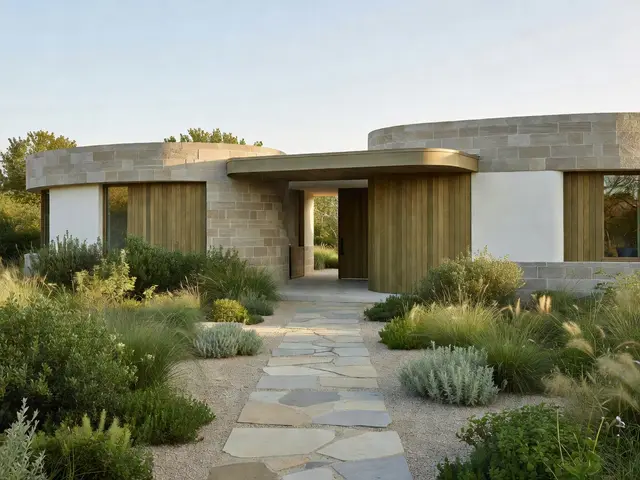
This single-story contemporary home presents a grounded, horizontal profile with a sheltered entry courtyard that serves as the organizing principle. Large-format concrete blocks form solid walls in a gray-beige tone, contrasted by vertical wood siding in a weathered finish. The entry path consists of irregular stepping stones set in fine gravel, surrounded by drought-tolerant plantings including ornamental grasses and silvery-green shrubs. A curved soffit marks the recessed entry, creating a sense of protected arrival.
Design this look with your photo ↗Your room photo + this reference. Review the studio allowance before generating.
What stands out
- Irregular stepping stones in varying sizes create an organic pathway through the gravel courtyard, slowing arrival and encouraging observation of the surrounding plantings rather than a direct march to the door.
- Vertical wood siding alternates with concrete block walls to break up solid masses, adding warmth and rhythm to the facade while maintaining the clean-lined contemporary profile.
- The recessed entry with curved soffit overhead provides sheltered transition space, visually drawing visitors forward while protecting the threshold from sun and weather.
- Low, massed plantings in silver-green and chartreuse tones soften hard edges without obscuring sightlines, offering a naturalistic buffer between public and private zones.
Make it work in your space
For a smaller lot, reduce the courtyard footprint but keep the stepping stone path to preserve the sense of gradual arrival. Substitute concrete block with poured concrete or stucco panels for similar mass at lower cost. Use fewer wood accents, concentrating them at the entry for maximum impact. Simplify plantings to three or four repeating species rather than a diverse mix. On a tight budget, skip the curved soffit and use a flat overhang, focusing resources on quality paving and one good wood element.
Keep the path visible and check drainage before enclosing a courtyard.
Materials and finishes
- Concrete masonry blocks
- Choose blocks with a smooth finish for cleaner contemporary lines. The gray-beige tone bridges warm and cool palettes. Standard eight-inch units keep costs down.
- Vertical wood siding
- Select a durable species suited to your climate. Weathered or naturally graying finishes reduce maintenance. Vertical orientation elongates modest wall heights and sheds water efficiently.
- Irregular flagstone pavers
- Pieces in varying sizes create organic pathways. Look for thickness consistency so stones sit level. Lighter colors reflect heat in sunny climates.
- Decomposed granite or fine gravel
- This permeable ground cover drains well and suppresses weeds. Stabilized versions reduce tracking indoors. Neutral tones complement surrounding plantings without competing visually.
- Curved metal or stucco soffit
- A smooth finish on the underside of overhangs adds polish. Curves soften boxy forms. Light colors reflect ambient light into shaded entry areas.
More Contemporary Exterior Ideas
Your questions, answered
How do you maintain gravel around stepping stones in a planted courtyard?
Edge the pathway with low plants or metal strips to contain gravel migration. Rake periodically to redistribute stones and prevent bare spots. Top-dress annually with fresh material to compensate for settling. Choose angular gravel over rounded pea gravel since it locks together better and resists spreading. Avoid heavy foot traffic when wet to prevent compaction and tracking indoors.
How do I try this look in my own space?
Choose Design this look and upload your own photo in the studio. This concept is loaded separately as a reference, and its design direction is included in the editable brief. Review your options before generating.
Can I buy the exact furniture and materials shown?
This is an AI-generated concept, not a catalog of real products. Use the image to compare shapes, colors, and materials, then verify dimensions and finishes with actual suppliers.