A direction for your next space
Japandi Exterior with Mixed Siding
About this design
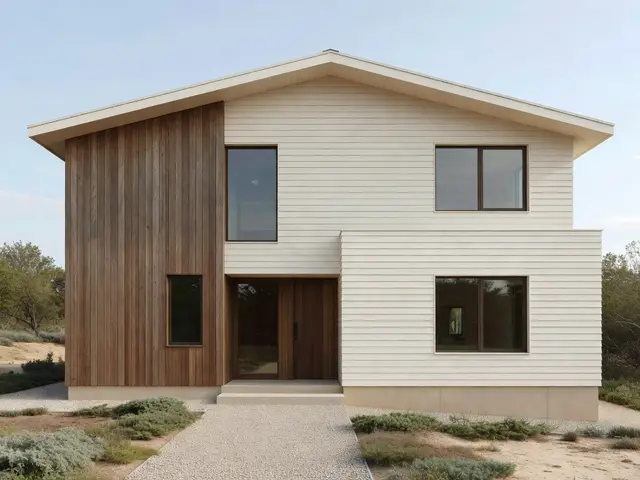
This two-story home uses contrasting siding materials to define separate volumes. The left section features vertical wood planks in a weathered brown tone, while the main facade is clad in horizontal off-white siding. Dark-framed windows punctuate both surfaces in an asymmetric arrangement. A recessed entry sits between the two volumes, protected by a wide soffit. The gable roof extends over both sections with minimal overhang, and the foundation sits on a concrete base surrounded by gravel and low native plantings.
Design this look with your photo ↗Your room photo + this reference. Review the studio allowance before generating.
What stands out
- Vertical wood siding anchors the left volume, creating a strong vertical line that contrasts with the horizontal boards on the main facade and grounds the overall composition.
- The off-white horizontal siding wraps the primary volume in clean lines, maintaining a quiet backdrop that allows the wood accent wall to stand out without competing for attention.
- Dark window frames against light siding create crisp boundaries and match the recessed entry, establishing a consistent detail that ties the different exterior materials together.
- A simple gable roofline unifies the two siding treatments, keeping the profile straightforward and avoiding decorative trim that would distract from the material interplay below.
Make it work in your space
For a smaller footprint, limit the wood accent to one corner or a partial wall rather than an entire volume. On a budget, skip the vertical wood siding and use a darker paint color on one section of horizontal siding to create visual separation. Maintain the clean window arrangement and dark frames, as these cost-effective details carry significant design impact. If the full gable roof is too complex, a simple shed roof over a single-story structure can achieve similar material contrast with less construction expense.
Align material transitions with architectural breaks rather than arbitrary stripes.
Materials and finishes
- Vertical wood plank siding
- Look for naturally durable species that weather to a silvered or soft brown finish. Boards should be uniform in width with tight joints to maintain clean vertical lines.
- Horizontal lap siding
- Choose fiber cement or engineered wood in a smooth finish. Consistent reveal and tight seams are essential for achieving the clean, uncluttered appearance this style requires.
- Dark aluminum window frames
- Select narrow profiles with minimal ornamentation. Matte or low-sheen finishes in charcoal or black provide definition without reflecting excessive light.
- Concrete foundation base
- A smooth trowel finish works best. The foundation should sit low to the grade, creating a modest plinth rather than a prominent raised base.
- Gravel ground cover
- Use small, uniform stones in neutral tones like tan or gray. Avoid large river rock or brightly colored aggregates that would disrupt the understated palette.
More Japandi Exterior Ideas
Your questions, answered
How do you maintain two different siding materials on the same house?
Vertical wood siding typically requires periodic cleaning and may need re-staining or sealing every few years depending on exposure and wood species. Horizontal fiber cement or engineered siding needs less maintenance, usually just washing and occasional repainting. Inspect both materials annually where they meet to ensure flashing and trim remain watertight, as the transition between different materials is vulnerable to moisture intrusion if not properly detailed during installation.
How do I try this look in my own space?
Choose Design this look and upload your own photo in the studio. This concept is loaded separately as a reference, and its design direction is included in the editable brief. Review your options before generating.
Can I buy the exact furniture and materials shown?
This is an AI-generated concept, not a catalog of real products. Use the image to compare shapes, colors, and materials, then verify dimensions and finishes with actual suppliers.