A direction for your next space
Mid-Century Modern Bathroom with Freestanding Tub
About this design
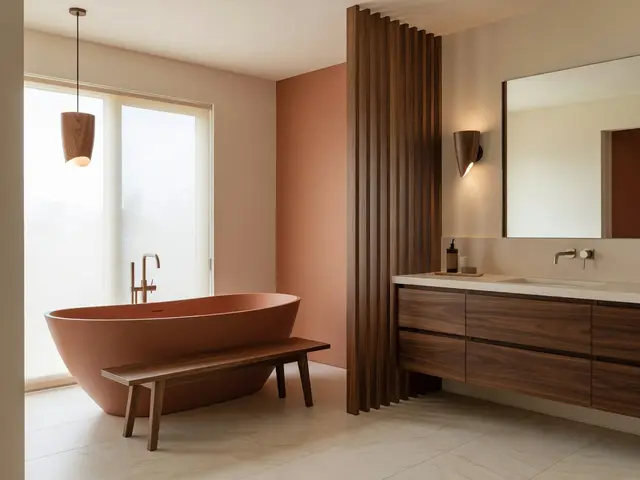
This mid-century modern bathroom centers on a sculptural freestanding tub in muted terracotta, positioned beside a full-height frosted window that floods the space with soft natural light. A walnut floating vanity spans the right wall, topped with pale stone and fitted with wall-mounted bronze fixtures. A vertical wooden slat partition separates the bathing zone from the vanity area, adding privacy without blocking light. Cream walls and pale floor tiles provide a neutral backdrop for the walnut and terracotta tones.
Design this look with your photo ↗Your room photo + this reference. Review the studio allowance before generating.
What stands out
- The terracotta freestanding tub has an elongated oval profile that emphasizes the sculptural, organic forms typical of mid-century design while providing a warm color anchor for the entire room.
- Vertical wooden slats in a warm brown finish create a room divider that maintains visual connection between zones while defining separate areas for bathing and grooming without solid walls.
- A simple wooden bench with tapered legs sits beside the tub, echoing mid-century furniture silhouettes and providing a practical spot for towels or bath accessories within easy reach.
- Wall-mounted bronze faucets and sconces in coordinating finishes add functional hardware that doubles as decorative elements, their warm metallic tones complementing the walnut and terracotta palette.
Make it work in your space
In a smaller bathroom, skip the full slat partition and use a half-height version or a single frosted glass panel instead. A smaller oval tub in the same terracotta tone maintains the focal point without overwhelming the space. Replace the floating vanity with a wall-hung version in similar walnut tones but reduce the length to 48 or 60 inches. Keep the window treatment and wall-mounted fixtures, as these take up no floor space. Swap the stone countertop for a more affordable quartz in a similar pale shade.
Check tub access, floor support and cleaning space around all sides.
Materials and finishes
- Terracotta tub finish
- Look for a matte or satin finish rather than high gloss. The surface should feel slightly textured and show subtle color variation that adds depth and a handcrafted quality.
- Walnut veneer cabinetry
- Choose book-matched or sequenced grain patterns for visual continuity across drawer fronts. The finish should have enough sheen to highlight the grain without appearing overly glossy or orange-toned.
- Pale stone vanity top
- Select a stone with minimal veining for a clean mid-century aesthetic. The surface should contrast with the walnut base while remaining neutral enough to let other elements stand out.
- Vertical wood slat partition
- Spacing between slats affects privacy and light flow. Slats should be uniform in width and finish, mounted securely to ceiling and floor for stability without visible hardware.
- Large format floor tiles
- Larger tiles reduce grout lines for a calmer visual field. Choose a neutral cream or beige with a matte finish to avoid competing with the warmer wood and terracotta tones.
More Mid-Century Modern Bathroom Ideas
Your questions, answered
How do you clean and maintain a terracotta finish bathtub?
Wipe the tub after each use with a soft cloth to prevent water spots and mineral buildup. Use a pH-neutral cleaner designed for unsealed or matte surfaces, avoiding abrasive scrubbers that can scratch the finish. For stubborn stains, make a paste of baking soda and water, apply gently, and rinse thoroughly. Depending on the specific finish, you may need to reseal periodically following the manufacturer's guidelines to maintain water resistance.
How do I try this look in my own space?
Choose Design this look and upload your own photo in the studio. This concept is loaded separately as a reference, and its design direction is included in the editable brief. Review your options before generating.
Can I buy the exact furniture and materials shown?
This is an AI-generated concept, not a catalog of real products. Use the image to compare shapes, colors, and materials, then verify dimensions and finishes with actual suppliers.