A direction for your next space
Farmhouse Exterior with Mixed Siding
About this design
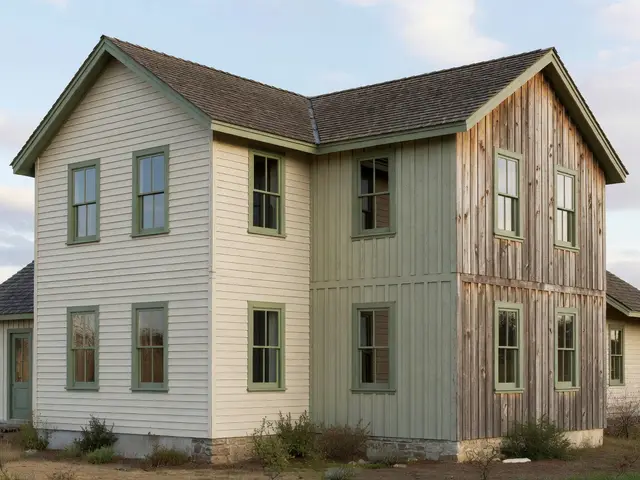
This two-story farmhouse exterior displays three distinct siding treatments across its facade. The left volume features horizontal lap siding painted in pale ivory, while the center section shows vertical board-and-batten siding in sage green. The right volume uses natural weathered wood vertical siding with a warm oak tone. Each section reads as a separate volume, unified by matching window trim in a soft cream color and a continuous dark gray roof. The composition demonstrates how different siding orientations and finishes can define architectural zones while maintaining visual harmony.
Design this look with your photo ↗Your room photo + this reference. Review the studio allowance before generating.
What stands out
- The horizontal lap siding on the ivory section creates traditional farmhouse character, its wider reveal casting subtle shadow lines that add depth and movement to the flat wall surface.
- Vertical board-and-batten siding in sage green marks the transitional center volume, its narrow battens and painted finish offering a smoother, more refined texture than the rougher wood cladding.
- Natural weathered wood vertical siding on the right section brings organic warmth and rustic texture, its unfinished boards showing variations in tone that add visual interest without additional paint.
- Consistent window trim color across all three siding types unifies the varied facade, the cream-toned frames providing a neutral border that ties together the ivory, green, and wood surfaces.
Make it work in your space
For a smaller single-story home, limit the approach to two siding types rather than three to avoid visual clutter. Keep the vertical-versus-horizontal contrast but reduce the number of color transitions. On a budget, paint all sections and use different siding orientations to create volume definition without purchasing multiple materials. Focus the natural wood treatment on a single accent wall or gable rather than an entire section. Maintain the unified trim color throughout, as this detail costs little but provides significant visual cohesion across varied surfaces.
Align material transitions with architectural breaks rather than arbitrary stripes.
Materials and finishes
- Horizontal lap siding
- Look for consistent board width and tight seams. Wider reveals cast stronger shadows. Pre-primed boards accept paint better and resist moisture when properly maintained with caulking at corners.
- Vertical board-and-batten siding
- Batten spacing should be regular and proportional to wall height. Ensure boards are properly spaced for expansion. Quality installation requires straight vertical alignment and weather-tight seals at horizontal joints.
- Natural vertical wood siding
- Choose rot-resistant species like cedar or cypress for durability. Expect color variation and weathering over time. Proper ventilation behind boards prevents moisture damage and extends lifespan significantly.
- Painted wood trim
- Select trim boards one to two inches wider than siding thickness for proper shadow lines. Prime all sides before installation. Use exterior-grade paint with UV protection for longevity.
- Asphalt shingle roofing
- Darker shingles like charcoal or brown anchor lighter siding colors. Check warranty length and wind rating. Proper attic ventilation and ice-and-water barrier extend roof life in all climates.
More Farmhouse Exterior Ideas
Your questions, answered
How do you transition between different siding types on the same exterior wall?
Transitions work best at inside or outside corners where walls naturally meet, as seen where each siding type occupies a distinct architectural volume. Use corner trim boards to create clean breaks between materials. Alternatively, place transitions at vertical breaks like pilasters or recessed wall sections. Avoid mid-wall transitions on flat surfaces, which look unfinished. Maintain the same reveal-to-wall plane depth across different siding types so no material protrudes further than another, ensuring a flush appearance at corners.
How do I try this look in my own space?
Choose Design this look and upload your own photo in the studio. This concept is loaded separately as a reference, and its design direction is included in the editable brief. Review your options before generating.
Can I buy the exact furniture and materials shown?
This is an AI-generated concept, not a catalog of real products. Use the image to compare shapes, colors, and materials, then verify dimensions and finishes with actual suppliers.